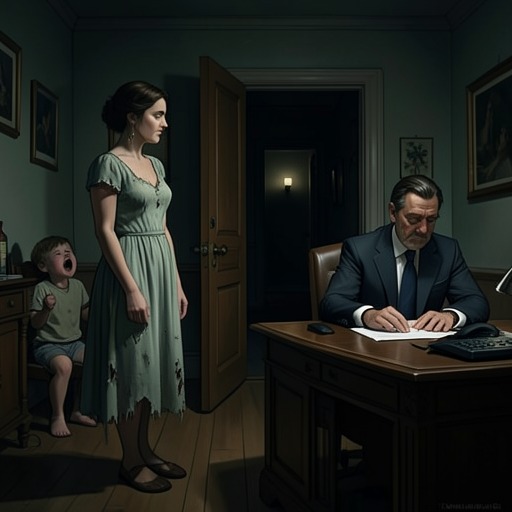
Elizabeth Bennet–Mrs. Bennet relationship
Just DesertsThe Elizabeth Bennet–Mrs. Bennet relationship is one of the central sources of Elizabeth’s early distress and later independence. Its conflict is not merely temperamental: Mrs. Bennet’s panic about the entail turns marriage into an emergency, while Elizabeth’s intelligence, curiosity, reading, and resistance to prescribed behavior make her unwilling to accept marriage as a duty performed for family survival. The relationship moves from daily confrontation and damaged self-esteem toward emotional withdrawal, as Elizabeth stops trying to reform her mother and begins constructing a life on different principles.
A Household Divided by Temperament
Elizabeth’s friction with Mrs. Bennet is established from the opening of the story. When her mother’s voice becomes shrill during preparations for Jane Bennet’s social debut, Elizabeth escapes Longbourn through the kitchen, taking a fresh roll from the cook before walking toward Oakham Mount. The escape is a practical response to an atmosphere she experiences as intrusive and disorderly: she is less afraid of being seen than of being stopped. Mrs. Bennet’s agitation is therefore not background noise but a force that shapes Elizabeth’s movements through the house and estate.
Elizabeth understands that she is her mother’s least favourite child. Their temperaments have produced harsh words throughout Elizabeth’s life, and Mrs. Bennet repeatedly interprets Elizabeth’s independence as a personal affront. Elizabeth, in turn, becomes Thomas Bennet’s favourite daughter because of her academic ability, her love of books, and her intellectual curiosity. That paternal preference does not repair the maternal bond; it makes the contrast within the family sharper. Elizabeth finds calm and intellectual companionship in her father’s book room, while her interactions with Mrs. Bennet are associated with interruption, criticism, and emotional excess.
The Entail and the Marriage Imperative
The deepest structural cause of the conflict is the entail on Longbourn. The estate is barred from passing through the female line, Mrs. Bennet can bear no more children, and Lydia Bennet’s birth eight years earlier has intensified her fear that no son will appear to preserve the family’s position. Mrs. Bennet’s dread of being “thrown into the hedgerows” drives her insistence that her daughters marry quickly and advantageously. Jane Bennet’s coming out at fifteen is, in Mrs. Bennet’s mind, not simply a social milestone but part of a campaign against financial and domestic ruin.
Elizabeth sees the connection between the entail and her mother’s behavior, but understanding it does not make the pressure acceptable. Her questions about why women are treated as second-class citizens receive only the answer that this is the way of the world. Mrs. Bennet’s urgency thus embodies a social system that gives women little control over property while compelling mothers to reproduce that system through their daughters. Elizabeth’s resistance is directed both at her mother’s manner and at the legal and economic conditions that make Mrs. Bennet’s panic intelligible.
The disagreement becomes especially visible when Elizabeth refuses William Collins’s marriage offer. Mrs. Bennet regards the refusal as an act of betrayal because Collins, as heir to Longbourn, represents the possibility of securing the family’s future. She blames Elizabeth for the household’s threatened displacement and treats Charlotte Lucas’s acceptance of Collins as evidence that another woman has taken the position Elizabeth ought to have claimed. For Elizabeth, however, accepting a marriage without affection would mean surrendering the very independence of judgment that Mrs. Bennet has spent years condemning.
Criticism, Reputation, and Withdrawal
Between the ages of ten and thirteen, Mrs. Bennet’s near-daily insults wear Elizabeth down until her self-esteem is almost nonexistent. Her mother calls attention to Elizabeth’s reading with Thomas Bennet and to her habit of walking about the countryside, presenting both as evidence that she is too unconventional to attract a husband. These criticisms do not remain isolated remarks; they create a household atmosphere in which Elizabeth’s ordinary interests are repeatedly recast as defects.
After Jane Bennet returns from Netherfield Park, Mrs. Bennet blames Elizabeth for forcing the return, despite Jane’s own denial. In the course of the outburst, Elizabeth is upgraded to a “hellion,” a label she perversely takes pride in because it marks a refusal to accept the role assigned to her. Mrs. Bennet also holds Elizabeth responsible for the departure of the Netherfield party, treating every disappointment in the family’s marriage prospects as another consequence of Elizabeth’s behavior. Her accusations convert social events into domestic prosecutions.
The arrival of Edward Gardiner and Madeline Gardiner at Christmas exposes the pattern to outsiders. Mrs. Bennet tells Edward Gardiner that Elizabeth has caused the family to suffer, rejected Collins, and endangered the daughters by allowing Charlotte Lucas to become mistress of Longbourn. The complaint reveals how completely Mrs. Bennet measures Elizabeth’s conduct by its supposed effect on marriage prospects. Elizabeth’s intellectual life, emotional needs, and objections to Collins disappear beneath the language of family duty and threatened eviction.
Elizabeth eventually stops calling the woman who gave birth to her “mother,” referring to her instead as Mrs. Bennet. The change in address records a decisive emotional separation. It does not result from a single quarrel but from years of criticism, combined with Elizabeth’s growing recognition that maternal authority is being used to force her into a marriage she cannot accept.
The Alternative Model of Womanhood
Elizabeth’s relationship with Mrs. Bennet changes when Elizabeth begins to receive another form of guidance from Radha Bhimani Pentland, whom she regards as a grandmother, and from the wider Pentland household. Mrs. Bennet treats Elizabeth as a daughter who must be corrected, subdued, and married; Lady Radha treats her as a person with intrinsic value. This difference allows Elizabeth to recover the self-esteem that maternal insults had nearly destroyed. Over two years, the biological mother’s continual attacks lose some of their power because Elizabeth has encountered a relationship in which her worth is not conditional on obedience or matrimonial success.
Lady Radha’s own history gives Elizabeth a powerful counterexample to Mrs. Bennet’s assumptions. Born Radha Bhimani in Kutch, she lost her mother in childbirth, was raised by her paternal grandmother and aunts, and grew up amid conflict involving the Mughals, the Marathas, and the British. At an age only a year older than Elizabeth is during their early conversations, she was kidnapped for sale into slavery. She was rescued off the Arabian Peninsula, transported by a Spanish ship, forced into a nunnery outside Cadiz, and later sent on a mission toward Cartagena. After pirates captured the ship, she suffered a stomach wound and was left behind when the surviving members of her order continued onward.
Sir David Pentland’s care and his refusal to treat Radha’s abuse as a reason for rejection provide Elizabeth with a model of marriage based on protection, respect, and partnership rather than purchase or social calculation. Radha explains that she was judged and shunned in Barbados even though she had been the victim of repeated crimes, and that the cruelty directed at her helped persuade Sir David to resign his naval commission. They returned to Britain, Radha converted superficially but willingly to the Church of Scotland, married near Edinburgh, and established their life together after purchasing their Hertfordshire estate. Mrs. Bennet’s fear makes marriage a transaction for survival; Radha’s example teaches Elizabeth that marriage can instead be a humane alliance between two people.
Elizabeth later tells the Gardiners that Madeline Gardiner and Lady Radha, despite their different backgrounds and social roles, taught her what mattered in being a lady: love and the practical responsibilities of daily life. She contrasts those lessons with the narrow instruction she receives from Mrs. Bennet. The comparison is not a rejection of female influence as such. It is a distinction between guidance that enlarges a woman’s agency and pressure that reduces her to a solution for a property problem.
Separation and Its Consequences
Elizabeth’s decision to leave Longbourn is the final practical consequence of the relationship. After Christmas, she asks the Gardiners privately for permission to return to London with them, acknowledging that she will not return to Longbourn when she leaves. She promises not to be a burden and proposes seeking work as a companion or governess. Her plan is made possible by approaching legal adulthood, by the support of the Gardiners, and by the emotional refuge she has found elsewhere.
Elizabeth’s departure is not an impulsive punishment of Mrs. Bennet. It is a deliberate withdrawal from a household in which her mother’s authority has become inseparable from humiliation and marriage pressure. The Gardiners have already packed Elizabeth’s most treasured belongings into their trunks, and Elizabeth plans to leave a note with Uncle Philips before taking the post-stage. The physical movement of her possessions marks a transfer of allegiance: Longbourn is no longer the unquestioned center of her life, while Gracechurch Street offers the possibility of protection, work, and self-direction.
The relationship therefore ends in estrangement rather than reconciliation. Elizabeth learns that she cannot change Mrs. Bennet’s behavior or her opinion of Elizabeth; the only person who can alter the pattern is Elizabeth herself, by refusing to react, refusing an unwanted marriage, and eventually leaving. Mrs. Bennet remains focused on the entail and on the daughters’ need to marry, while Elizabeth carries forward the contrasting lessons of the Gardiners and the Pentlands. Their conflict gives Elizabeth an early education in the difference between biological authority and moral care, and it helps explain why her later choices are grounded in affection, practical responsibility, and the demand for adult independence rather than in fear of being cast out.